Back to Science and Technology Group page
Tuesday 13th October. - 'Projects that went nowhere' by Adrian Hickson
Adrian outlined several projects that really had no hope of being accomplished. An irrigation scheme planned for Majorca that had no water, not even a reservoir, but also lacked a power supply.
Two power stations in South Africa were to share a water supply. They were only 6 miles apart but had no pipes to carry the water.
In Athens an energy management system had been set up with the heating on in August. Also an automatic lighting system was installed in corridors with no outside windows. To make it more difficult all the cabling was the same colour, black.
In Spain a mercury mine used chlorinated water as drinking water. Many of the workers had mercury poisoning despite all the precautions.
Adrian was involved in Sellafield’s preparations for the year 2000. They found that all the tapes used for backups were blank so could not be used to restore in the event of problems.
Adrian also worked on the Charing Cross Embankment station. Work was not going well but had to be finished in time for the Olympics. This is also where Skyfall was filmed. At one point Daniel Craig who starred in the film was moved off the site.
In Manchester the council installed automatic bus stop signs to display the time of the next bus. The bus drivers did not like the system so they frequently unplugged it in their cabs. Also the units were not fixed to the floor so were free to roll around as the bus drove round its route. The only good point in the system’s favour, it did show the time correctly.
This was a fascinating talk by someone who was well versed in the technologies he was describing. It’s just amazing that anything works. Fortunately, the display system at Packington Hall worked perfectly, for Adrian’s talk.
Thursday 10th September - 'Visit to Woolsthorpe Manor'
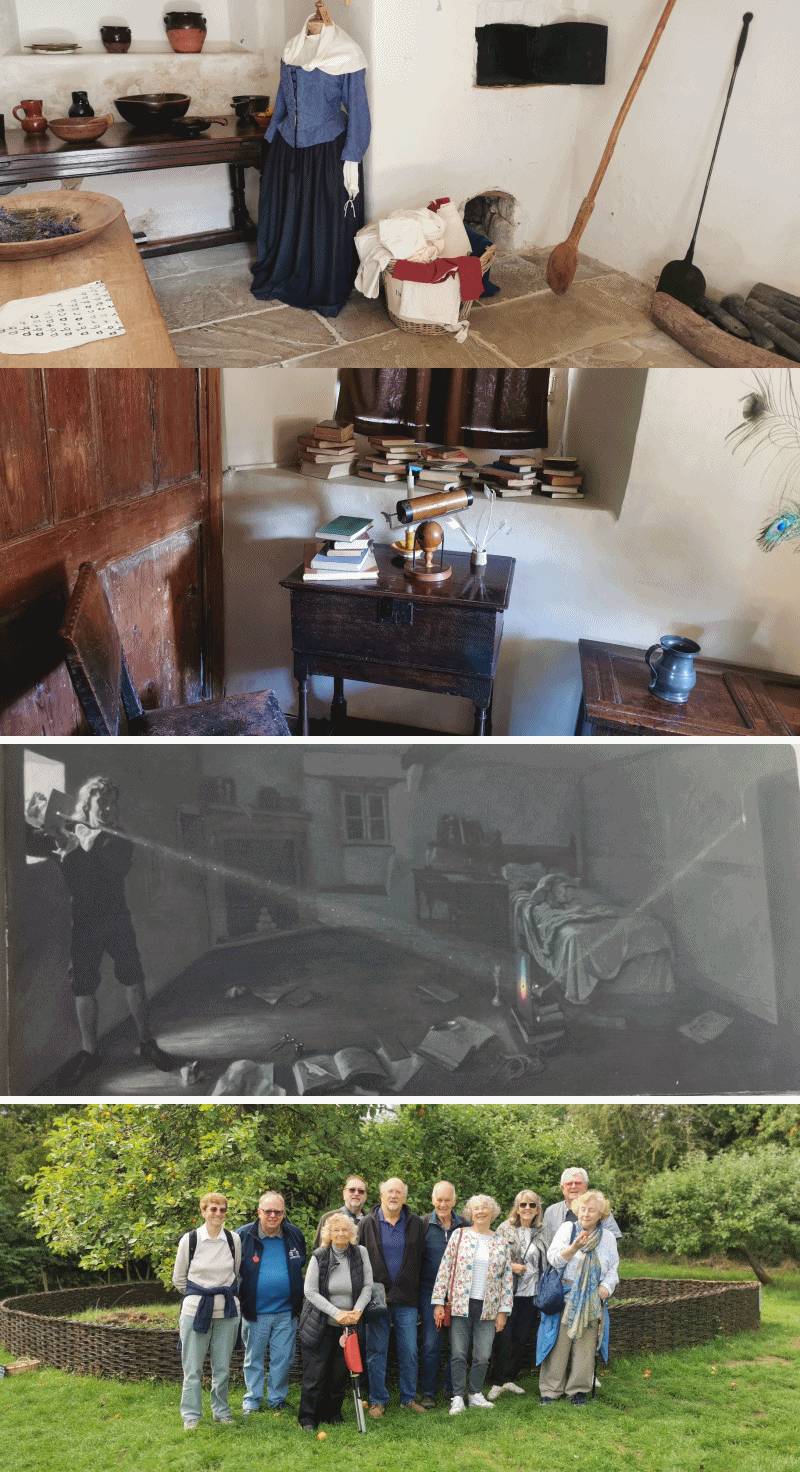
Woolsthorpe Manor is the birth place and family home of Sir Isaac Newton, a farmhouse set in the picturesque Lincolnshire countryside, now run by the National Trust. Eleven members had made the 45 mile journey on a lovely warm and sunny morning for a guided tour of the farmhouse. The venue is special because it was here that Newton carried out his experiments on light and discovered the universal force of gravity that explained the orbits of planets and why an apple always falls vertically to the ground.
Our guide described how the baby Isaac was not expected to survive for long, he was so small and weak, and how is father died months before Isaac’s birth. When his mother remarried, she left Isaac in the care of his grandmother, a desertion that may have accounted for his rather cold and harsh personality. Our tour continued from the parlour to the hall then into the kitchen with a bread-making oven built into the hearth, advanced features for the mid-17th century. Many rooms showed wall etchings of geometric shapes and scribbled notes made by Newton as ideas came into his brain. These were most evident in his bedroom, where holes were created to allow sunlight to enter a glass prism revealing the colours of the rainbow. In the 17th century paper was expensive so the white-washed blank walls were used instead.
Newton was curious to find out how the wind powered a mill so he watched workmen building one nearby and grasped the principles so well he built a scale model version, a replica of which was on display. This showed Newton’s grasp of mechanical devices, a skill he combined with his understanding of optics to invent the first reflecting telescope, a model of which was on display in Newton’s bedroom. This used a polished parabolic metal surface to focus light and give a magnified image that was superior to that produced by Galileo’s lenses in his refracting telescope.
The tour then visited the garden where the group was shown an old apple tree surrounded by a low wicker-work fence. The original tree believed to be the source of Newton’s discovery of gravity was damaged by a storm in the early 19th Century but the recumbent trunk subsequently grew saplings to form the tree we see today. The guide described how seeds/pips from this tree travelled with Tim Peake millions of miles in orbit around the Earth in the International Space Station before being germinated into saplings, one of which was planted at Woolsthorpe. The guide explained that, unfortunately, the sapling struggled to develop and is currently being cared for at Kew Gardens.
The guide told that Newton often had problems dealing with colleagues, particularly when they criticised his scientific work. This happened with Robert Hooke (over who discovered the inverse square law for gravity), with Gottfried von Leibniz (over the invention of calculus) and even with the first Astronomer Royal to the King Charles 2nd John Flamsteed (over orbital data for the Moon). Perhaps Newton’s irritation with these highly respected scientists was due to stress and tiredness from his very demanding work schedule, often forgetting to eat and sleep.
Following the tour, we were free to explore the Science Centre. This had displays and models explaining Newton’s discoveries in a practical way. One model explained how gravity could be opposed by centripetal force; a vertical wheel containing a bean bag could be rotated fast enough to create a centrifugal force that held the bag against gravity. Another demonstration showed how a beam of white light shining through a prism displayed the constituent colours and when it was passed through a second prism, it emerged as white light. Once the guided tours finished we were free to explore the Manor House further at our leisure. Overall, a fascinating scientific and historical experience brought to life by our lively and knowledgeable National Trust guide.
Tuesday 14th July - 'Submarines' by Paul McKay
For this meeting we planned a virtual talk via Zoom by u3a speaker David Dundas called ‘Why Hydrogen’, however, the IT system had other plans. We connected to the internet and Zoom displayed a video image of David and myself, but with no audio from David. We tried for over 30 minutes, and even with the kind help from our patient members, we could not connect with David.
With time pressing on, David and I agreed to abandon Zoom and to re-arrange for his talk to be given ‘in person’, as he lives in Lichfield, a reasonable travelling distance. To make the best of the situation, I delivered a pre-prepared talk called Submarines, describing my career below and above the waves.
My talk combined basic science, submarine technology and work experience. Inspiration for my lifelong interest in diving and underwater technology stemmed from an ITV programme ‘Sea Hunt,’ aired in the late 1950’s, starring Lloyd Bridges as an intrepid diver (Mike Nelson).
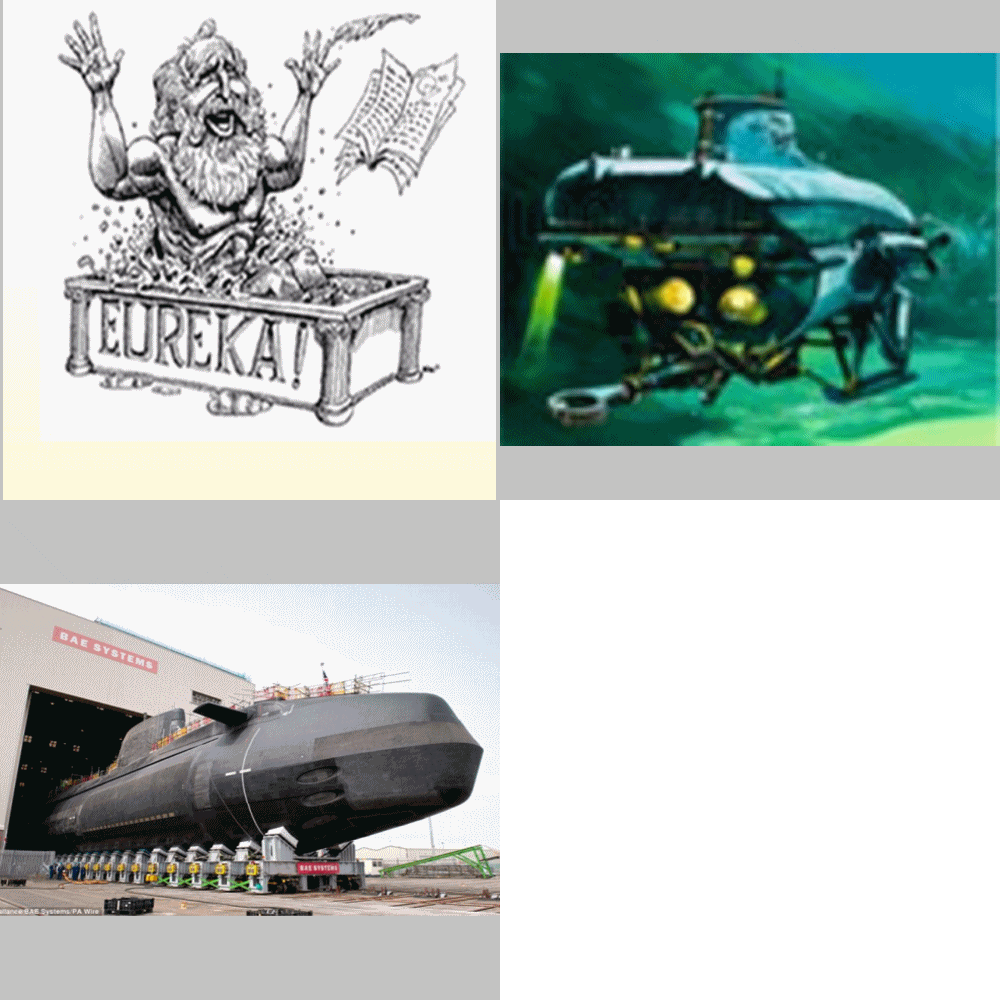
Later, training with submarine builder’s Vickers at Barrow-in-Furness balanced the fiction with the harsh reality of shipyard submarine construction. The relevance of Archimedes Principle and Boyle’s Law to submarine diving operations were explained and demonstrated by diagrams and a video of a military submarine diving by venting ballast tanks.
The structure and operation of commercial mini- submersibles in support of oil and gas production and torpedo recovery was covered. Then, based on my experience as a design engineer at Rolls-Royce Submarines in Derby, the design and operation of Royal Navy nuclear submarines was described. Due to shortage of time, the talk had to be curtailed to make way for a very welcome drink!
For August we take a Summer break, so our next meeting will be a visit on THURSDAY 10th September, to Woolsthorpe Manor, birthplace and residence of Sir Isaac Newton.
Please email science@ashbyu3a.co.uk or pmckay189@gmail.com to register your interest and get further details of the visit